Football / Soccer
-
£12.99 -
POWERbreathe Classic (LR)
Light Resistance£29.99 -
POWERbreathe Classic (MR)
Medium Resistance£29.99 -
POWERbreathe Classic (HR)
Heavy Resistance£29.99
-
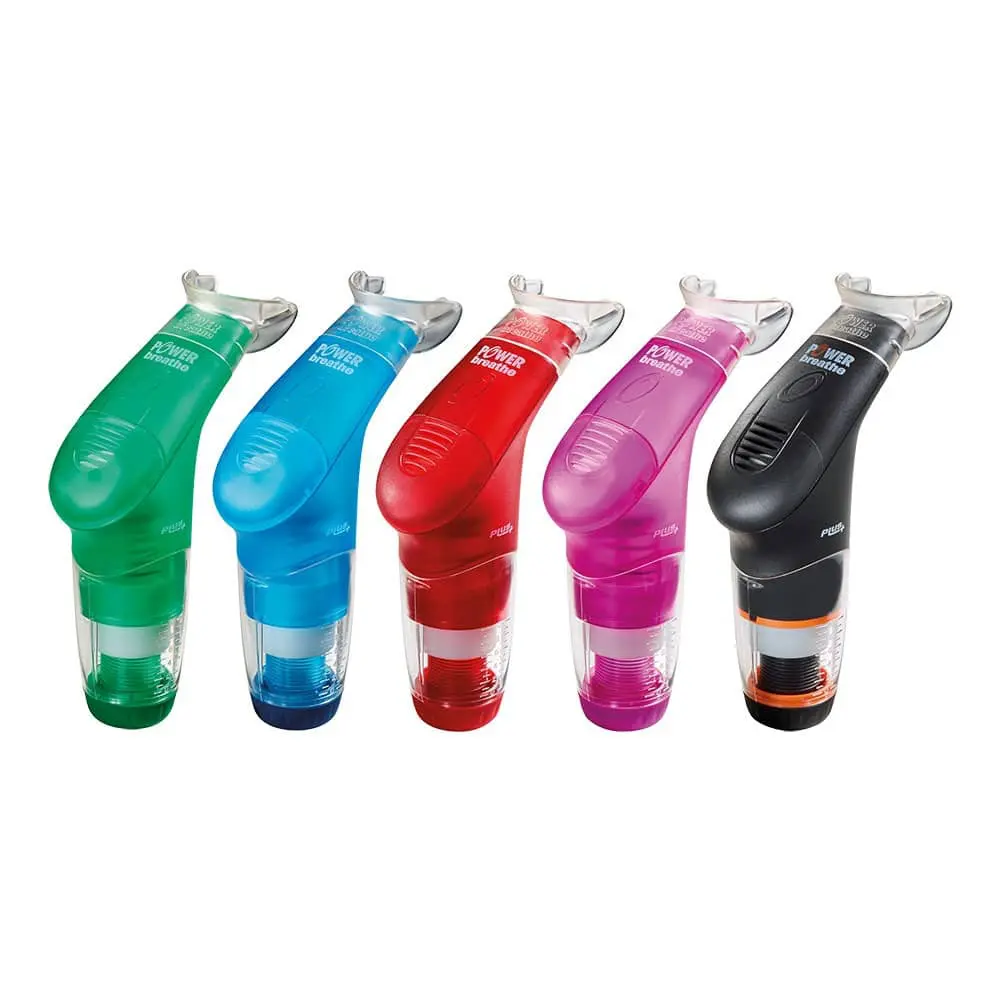
POWERbreathe Plus (LR)
Light Resistance£49.99 -
POWERbreathe Plus (MR)
Medium resistance£49.99 -
POWERbreathe Plus (HR)
Heavy Resistance£49.99 -
POWERbreathe Iron Girl Plus (LR)
Light Resistance£49.99
-
POWERbreathe Plus Medium Resistance (Pink)
Medium Resistance£49.99 -
POWERbreathe Iron Girl Plus (HR)
Heavy Resistance£49.99 -
POWERbreathe Ironman Plus (LR)
Light Resistance£49.99 -
POWERbreathe Plus Special Edition (MR)
Medium Resistance£49.99
-
POWERbreathe Plus (MR)
Limited Edition Lilac£49.99 -
POWERbreathe Plus (MR)
Limited Edition Amethyst£49.99 -
POWERbreathe Plus Special Edition Black Level 3 (HR)
Heavy Resistance£49.99 -
POWERbreathe K1
Entry level advanced auto-training£249.99
Breathing Effort in Football & Soccer
As a football / soccer player you’re likely to cover approximately 10-12 km during the course of a match, and do it at an average intensity of 75-80% of your maximal oxygen uptake (VO2 max.). Throughout the 90 minutes of the game you’ll cruise for 30-90 seconds and sprint for 3-5 seconds.
Although most activity during your match will be sub-maximal, your intermittent sprints are supra-maximal. This pattern of exertion places extreme demands upon your breathing because these activities are anaerobic and generate high levels of lactic acid. Lactic acid stimulates breathing to increase as part of a compensatory strategy to overt fatigue of other muscles, such as your legs, which inevitably impairs your performance.
Inspiratory Muscle Training:
- Accelerated recovery during repeated sprints by up to 7%
- Improved inspiratory muscle strength by 31.2%
- Improved inspiratory muscle endurance by 27.8%
- Reduced whole body effort during exercise
- Improved performance within 4-weeks (following tried & tested training regimen
Breathing Training
show-
Following a sprint your breathing is driven to its highest level, inducing extreme breathlessness, and if you are to continue to make an active and effective contribution to the game, your breathing must recover quickly. Inspiratory muscle training with POWERbreathe is proven to help you recover more quickly.
Strong breathing muscles are also essential for the twisting and flexing movements of your trunk and make a contribution to stabilising and turning your body during kicking, as well as flexing your upper body during heading, so fatigue of the breathing muscles can affect more than running ability. Inspiratory muscle training with POWERbreathe is scientifically proven to improve your breathing strength and stamina, helping you avoid that feeling of breathing muscle fatigue.
-
Warm-up with POWERbreathe for Football & Soccer
show-
A POWERbreathe warm-up boosts your inspiratory muscle performance.
Research has shown that a standard pre-exercise warm-up routine fails to prepare the inspiratory muscles (breathing muscles) for the rigours of exercise1, and an inspiratory warm-up was shown to improve performance (in rowers)2.
1 Specific respiratory warm-up improves rowing performance and exertional dyspnoea.
2 Inspiratory muscle training improves rowing performance.
More about POWERbreathe for warm-up can be found in our sports Training section.
-
Cool-down & recover with POWERbreathe for Football & Soccer
show-
A POWERbreathe cool-down reduces lactate during exercise & speeds up clearance.
As well as helping football players and soccer players to recover more rapidly and avoid breathing muscle fatigue, inspiratory muscle training with POWERbreathe can be used as part of a pre-match and pre-substitution warm-up. By warming-up the breathing muscles the sense of increased breathing effort and breathlessness experienced during the first few minutes of activity can be avoided.
A POWERbreathe ‘cool-down’ can help to speed lactate clearance even more effectively than traditional active recovery strategies.
Researchers at the University of Sao Paulo in Brazil have found that breathing against a small inspiratory load immediately after exercise reduces lactate by 16%.1 What’s more, unlike a normal active recovery, which takes around five minutes to speed-up lactate clearance, inspiratory loading reduces lactate as soon as exercise stops. Furthermore, when using the inspiratory load, lactate concentration after just 5 minutes was equivalent to that achieved in 15 minutes during passive recovery.
1 Blood lactate during recovery from intense exercise: impact of inspiratory loading.
More about POWERbreathe for cool-down can be found in our sports Training section.
-
Interval Training with POWERbreathe for Football & Soccer
show-
Integrating POWERbreathe into your interval training will improve your respiratory endurance and hasten recovery.
More about POWERbreathe interval training can be found in our sports Training section.
-
Resources
showResearch
show-
Inspiratory Muscle Training
- Entraînement de la force des muscles inspiratoires chez le sujet sportif amateur (Inspiratory muscles strength training in recreational athletes)
- Inspiratory muscle warm-up and inspiratory muscle training: Separate and combined effects on intermittent running to exhaustion
- Inspiratory muscle training enhances pulmonary O2 uptake kinetics and high-intensity exercise tolerance in humans
- The effect of inspiratory muscle training on high-intensity, intermittent running performance to exhaustion.
- The influence of respiratory muscle training upon intermittent exercise performance.
- Effects of inspiratory muscle training upon recovery time during high intensity, repetitive sprint activity.
- The effect of inspiratory muscle training on high-intensity, intermittent running performance to exhaustion.
Warm-up and Cool-down
- Inspiratory resistive loading after all-out exercise improves subsequent performance.
- Effect of specific inspiratory muscle warm-up on intense intermittent run to exhaustion.
- Blood lactate during recovery from intense exercise: impact of inspiratory loading.
- Inspiratory muscle training reduces blood lactate concentration during volitional hyperpnoea.
Exercise-induced Inspiratory Muscle Fatigue
- Influence of environmental temperature on exercise-induced inspiratory muscle fatigue.
- Aerobic fitness effects on exercise-induced low-frequency diaphragm fatigue.
- Exercise-induced diaphragmatic fatigue in healthy humans.
- The effect of exercise modality on respiratory muscle performance in triathletes.
- A comparison of inspiratory muscle fatigue following maximal exercise in moderately trained males and females.
- Inspiratory muscles experience fatigue faster than the calf muscles during treadmill marching.
Miscellaneous
- Development of respiratory muscle contractile fatigue in the course of hyperpnoea.
- Inspiratory muscle training attenuates the human respiratory muscle metaboreflex.
- Development and evaluation of a pressure threshold inspiratory muscle trainer for use in the context of sports performance.
- Specificity and reversibility of inspiratory muscle training.
- Inspiratory muscle training: a simple cost-effective treatment for inspiratory stridor.
Review Articles
- Effects of respiratory muscle training on performance in athletes: a systematic review with meta-analyses
- Effect of respiratory muscle training on exercise performance in healthy individuals: a systematic review and meta-analysis
- Inspiratory muscle training and endurance: a central metabolic control perspective.
- Does training of respiratory muscles affect exercise performance in healthy subjects?
- Respiratory muscle energetics during exercise in healthy subjects and patients with COPD.
- Respiratory muscle training in healthy humans: resolving the controversy.
-